

Control and Trust Cannot Coexist
It is 3am in Hanoi, Vietnam. Here is the nagging premise I cannot shake loose: control and trust cannot exist at the same time. Watch what happens when a leader says they want to be responsible, thorough, informed — and then requires every recommendation to be walked through before anything moves.

What Leaders Should Do With Feedback
This is Part 4 of a four-part series on feedback and leadership. Feedback is not instruction. It is data. Leadership becomes the discipline of interpreting that data with clarity and judgment.

The Discipline of Listening to Feedback
Most leaders believe receiving feedback is about agreement. In reality, it is about discipline.

Why Leaders Defend the Feedback They Ask For
This article is the second in a four-part series on what I call The Feedback Paradox, why one of the most powerful tools for improving leadership and culture is also one of the most avoided.

The Hidden Power and Discomfort of Feedback
This article begins a short series exploring why feedback is one of the most powerful tools for improving leadership and culture, yet also one of the most avoided.

If They Don't Roll Their Eyes, You Haven't Said It Enough
One of the U.S. presidents in my formative years was Ronald Reagan. He was known as "The Great Communicator." What I remember most is not the policy detail. It is the language. Leadership in business requires the same discipline.

When Leaders Don't Model Shared Tools, Momentum Stalls
When momentum stalls, it is rarely because the strategy was flawed. It is usually because the discipline was not modeled.

You Measure Equipment Variance. Why Not Leadership Variance?
The same organizations that control mechanical variance with precision can unintentionally tolerate variance in leadership behavior. If culture is muscle memory, then leadership behavior is muscle memory too — and it will produce exactly what it has been trained to produce.

From Force to Flow: The Physics of Culture Momentum
Most culture transformations feel heavy at the beginning. Like something large that refuses to move. There is visible effort, public endorsement, and structured cadence — and still, progress feels slower than expected. Many leaders assume something is wrong. It isn't. It's physics.

Is It Psychological Safety, or Is It Courage?
Lately, I have found myself raising one eyebrow every time I hear the phrase, "We do not have psychological safety." It has become the universal explanation for why people do not speak up. And yes, psychological safety matters. But here is the uncomfortable question: Is it actually a safety issue, or is it a courage issue?

Cultural Beliefs Erode Through Convenience
Leaders often assume culture fails in moments of crisis. In practice, culture is usually strongest when stakes are high and attention is focused. What undermines culture far more often are the quieter moments, when decisions feel reasonable, isolated, and expedient.
What Actually Reduces Human Suffering in Coaching
What determines whether coaching genuinely helps or subtly harms is not the brilliance of the coach's question or the rigor of a certification. It's the state of presence in which the conversation happens.

Purpose Is Not Optional. It Is an Energy Source.
People work for money. They work harder for good leaders. But they work hardest for a cause they believe in. When purpose is muted, results rely on force instead of commitment. Force and commitment are two very different energy sources.

Why Are You Resistant to Coaching?
Resistance to coaching rarely has anything to do with intelligence, experience, or competence. The most capable leaders can sometimes be the most hesitant — not because they don't care about growth, but because coaching asks something unusual of them.

Leadership Is Not Either/Or. It's AND.
Leaders often fail not by choosing the wrong value, but by over-indexing on a good one. Real leadership asks us to stay present with tension rather than rush to resolve it. If leadership feels comfortable, it often means something important was deferred.

When Leaders Say "I Don't Have Time," This Is What They're Communicating
Time is the only resource distributed equally. CEOs do not get more hours than frontline supervisors. What leaders do get is discretion. So when leaders say 'I don't have time,' what they are often really saying reveals a leadership belief, not a scheduling issue.

E Pluribus Unum: What a Latin Phrase Is Teaching Me About Culture
The original idea was not that the many would disappear. It was that many distinct colonies, cultures, and identities could voluntarily align around a purpose larger than themselves. Unity was not meant to erase differences — it was meant to give differences a shared direction.

You May Be Carrying Trauma and Not Know It
The stress many people are carrying today is not abstract. When stress does not resolve, it does not disappear — it adapts. It shapes behavior and hardens patterns, often getting mistaken for personality, professionalism, or strength.

Change Fails Before the Work Begins
Most culture initiatives do not stall because leaders disagree that change is needed. Change fails because the people involved are not regulated enough, in relation to one another, to examine behavior honestly.

The Scapegoat Mechanism: How Culture Change Stalls Without Us Noticing
Over many years of working with organizations on culture change, I have seen a consistent pattern repeat itself. Teams begin with energy and intent, early progress feels real, then something subtle happens. The scapegoat mechanism appears whenever change creates discomfort.

The Quiet Harm of "Should" and "Could" in Leadership
Two words quietly shape the inner experience of many leaders, often without their awareness. They sound reasonable, even responsible — but they are rarely neutral. More often, they are the doorway through which suffering enters leadership.

What Breakfast at Tiffany's Taught Me About Executive Decision-Making
Most people know Breakfast at Tiffany's for its iconic style. What struck me most wasn't the fashion, but the psychology — and the pattern I see play out in executive suites all the time.

What I Learned About Suffering Standing in the Ashes
On January 9, 2025, my childhood home in Altadena, California was gone. Not damaged. Not partially standing. Gone. What surprised me most was not the absence of pain, but the absence of suffering taking hold.

How High Performing Teams Successfully Move Organizational Culture
What are the components of a high performing team, and how can they contribute to the desired organizational culture? Four key components with practical application tools and culture dynamics.
Coaching Leaders to Lead the Culture
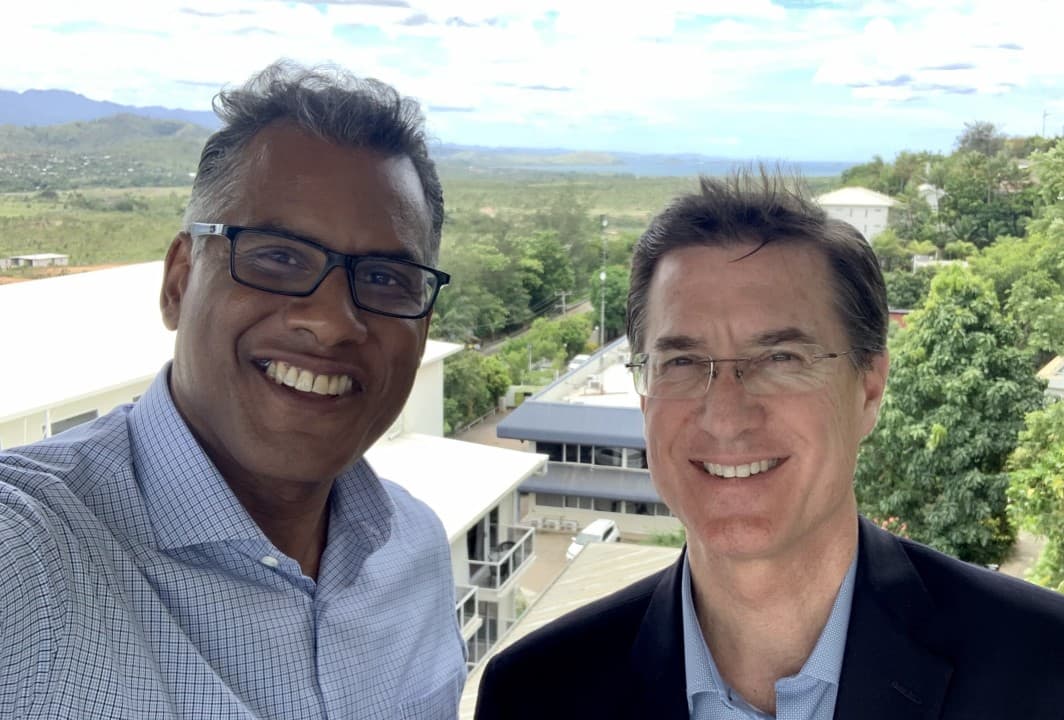
Working with executive teams in Papua New Guinea on three principles for leading organizational culture change and delivering Key Results.